
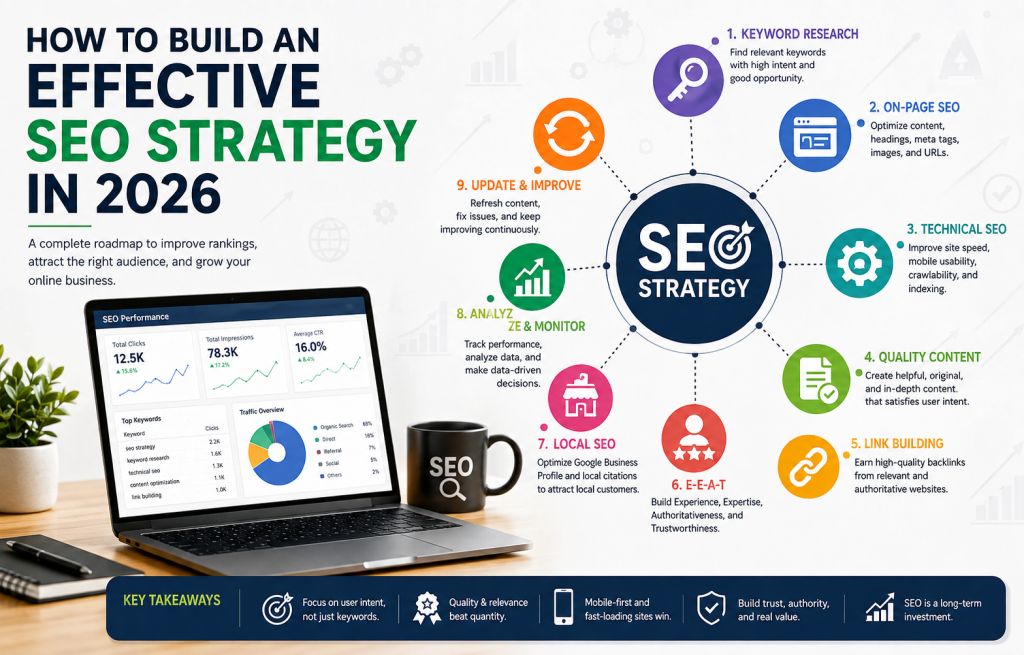

Search engine optimization (SEO) continues to be one of the most powerful ways to grow a website, attract qualified visitors, and build long-term online visibility. However, SEO in 2026 is very different from the traditional approach of simply adding keywords to articles and building as many backlinks as possible.
Search engines are becoming better at understanding context, user intent, content quality, entities, and real-world expertise. At the same time, AI-powered search experiences are changing how people discover information online. A successful SEO strategy therefore needs to focus on usefulness, authority, technical performance, user experience, and consistent optimization.
Whether you run an e-commerce store, local business, SaaS company, blog, or agency website, the fundamentals remain the same: understand your audience, create genuinely useful content, make your website technically strong, establish authority, and continuously measure your results.
Here is a practical step-by-step guide to building an effective SEO strategy in 2026.
1. Define Clear SEO Goals
Before researching keywords or publishing content, determine what you want SEO to accomplish.
Increasing organic traffic is a common goal, but traffic alone does not necessarily generate revenue. Your SEO objectives should be connected to business outcomes.
For example, your goals could include:
- Increasing qualified organic traffic
- Generating more leads
- Increasing online sales
- Improving visibility for commercial keywords
- Increasing local search visibility
- Building brand awareness
- Growing organic conversions
- Establishing authority in a specific industry
Set measurable targets. Instead of saying, “I want more traffic,” create a goal such as increasing qualified organic traffic by 30% over six months or generating 50 additional organic leads per month.
Clear objectives will help you decide which keywords, pages, and SEO activities deserve the most attention.
2. Understand Your Target Audience and Search Intent
Modern SEO is not just about ranking for keywords. It is about satisfying the reason behind a search.
Search intent generally falls into several categories:
Informational intent: The user wants to learn something.
Examples include “how does SEO work?” or “how to choose running shoes.”
Navigational intent: The user is looking for a specific website or brand.
For example, someone searching for a particular company’s login page.
Commercial investigation: The user is researching products or services before making a decision.
Examples include “best SEO tools” or “best accounting software for small businesses.”
Transactional intent: The user is ready to take action, such as buying a product or hiring a service.
Understanding intent allows you to create the right type of page for each search.
If someone searches for “best laptops for students,” a product comparison or buying guide may be more appropriate than a general article explaining what a laptop is.
3. Perform Comprehensive Keyword Research
Keyword research remains important in 2026, but the process has become more sophisticated.
Instead of focusing on one primary keyword, build topic clusters around a central subject. Identify the main topic, related questions, supporting concepts, long-tail searches, and commercially valuable terms.
Look for keywords based on:
- Search intent
- Relevance to your business
- Search demand
- Competition
- Conversion potential
- Current rankings
- Long-tail opportunities
Long-tail keywords can be particularly valuable because they often indicate a more specific need.
For example, instead of targeting only “SEO services,” you might target phrases such as “affordable SEO services for small businesses” or “technical SEO services for e-commerce websites.”
However, avoid forcing exact-match keywords into every paragraph. Search engines can understand related terminology and context, so natural language is usually more effective.
4. Analyze the Competition
A strong SEO strategy requires understanding what already ranks.
Choose your target keywords and examine the top-ranking pages. Analyze what these pages have in common and identify opportunities to create something better.
Look at:
- Content depth
- Page structure
- Search intent
- Topics covered
- Original research
- Visual elements
- Internal links
- Backlink profiles
- Page experience
- Author expertise
Do not simply copy competitors. Instead, identify weaknesses.
Perhaps competing pages are outdated, poorly organized, missing important questions, or lacking practical examples. Those gaps provide opportunities for your content to offer more value.
Your objective should not be “How can I write a longer article?”
Instead, ask:
“How can I create the most useful result for this search?”
5. Build a Strong Website Structure
Website architecture plays an important role in SEO.
Your site should have a logical structure that allows both users and search engines to understand how different pages relate to each other.
A typical structure might look like:
Homepage → Category → Subcategory → Individual Page
For example:
Homepage → SEO Services → Technical SEO → Technical SEO Audit
Use descriptive URLs, logical navigation, breadcrumbs, and relevant internal links.
Avoid creating unnecessary levels of navigation that make important pages difficult to reach.
A well-structured website also makes it easier to distribute authority through internal links.
6. Create High-Quality, People-First Content
Content remains a major part of SEO, but publishing large quantities of generic AI-generated articles is not a sustainable strategy.
In 2026, websites need content that provides genuine value.
Good content should:
- Answer the user’s question clearly
- Demonstrate relevant expertise
- Provide useful examples
- Include accurate information
- Be easy to read
- Address related questions
- Offer original insights where possible
- Be regularly reviewed and updated
AI can help with research, brainstorming, outlining, editing, and productivity. However, relying on AI to produce large volumes of generic content without meaningful human input can result in repetitive and low-value pages.
Add real experience, original examples, expert opinions, data, case studies, screenshots, or unique analysis whenever possible.
7. Optimize On-Page SEO
On-page SEO helps search engines understand the purpose and relevance of individual pages.
Important elements include:
Title Tag
Create a clear and compelling title that accurately represents the page.
Meta Description
Write a useful description that encourages qualified users to click from search results.
Headings
Use logical H1, H2, and H3 headings to organize the content.
Keywords
Use relevant terms naturally in important areas such as the title, headings, introduction, body content, image descriptions, and URL when appropriate.
Images
Compress images and use descriptive file names and alt text where relevant.
Internal Links
Link to related pages using descriptive anchor text.
The goal is not to optimize every element mechanically. The goal is to make the page understandable, useful, and easy to navigate.
8. Focus on Technical SEO
Even excellent content can struggle if a website has serious technical problems.
Regularly audit your website for:
- Crawlability issues
- Indexing problems
- Broken links
- Redirect errors
- Duplicate content
- Incorrect canonical tags
- XML sitemap problems
- Poor mobile usability
- Slow page performance
- JavaScript-related rendering issues
- HTTPS problems
Monitor your website using tools such as Google Search Console and other SEO platforms.
Technical SEO should not be treated as a one-time project. Websites change constantly, so regular monitoring is essential.
9. Improve Page Experience and Core Web Vitals
User experience is increasingly important because search engines want to direct users toward websites that provide a good experience.
Pay attention to loading speed, mobile usability, layout stability, and interaction responsiveness.
Optimize large images, reduce unnecessary scripts, use efficient hosting, and remove technical elements that slow down important pages.
However, do not obsess over achieving perfect technical scores while ignoring content quality.
A fast website with poor content will not automatically become a successful SEO website.
Technical performance and useful content should work together.
10. Develop a Strategic Internal Linking System
Internal links are one of the most overlooked SEO opportunities.
They help users discover related content while also helping search engines understand the relationships between pages.
For example, if you have an article about “keyword research,” you can naturally link to related pages about:
- Search intent
- On-page SEO
- Content strategy
- SEO tools
- Competitor analysis
Create topic clusters where supporting articles connect to a central pillar page.
Use descriptive anchor text rather than repeatedly using generic phrases such as “click here.”
A strong internal linking strategy can improve navigation, distribute authority, and help important pages receive more visibility.
11. Build High-Quality Backlinks
Backlinks remain an important part of establishing website authority, but quality is much more important than quantity.
One relevant backlink from a trusted industry website can be more valuable than dozens of unrelated links.
Effective link-building methods include:
- Digital PR
- Expert contributions
- Guest posting on relevant websites
- Original research
- Industry studies
- Linkable resources
- Data-driven content
- Partnerships
- Expert interviews
- Useful tools and calculators
Avoid building links solely for volume.
Do not participate in obvious link schemes, automated link networks, or low-quality backlink packages that promise hundreds or thousands of links.
Focus on earning links because your content is genuinely useful or because your expertise is relevant.
12. Strengthen E-E-A-T Signals
Experience, Expertise, Authoritativeness, and Trustworthiness are important concepts when evaluating content quality.
Make it easy for visitors to understand who created your content and why they should trust the information.
Consider adding:
- Author bios
- Professional credentials where relevant
- Editorial policies
- Contact information
- About pages
- Sources and references
- First-hand experiences
- Original research
- Customer reviews
- Case studies
For topics involving significant financial, legal, health, or safety consequences, accuracy and trustworthy sourcing become especially important.
Your website should communicate credibility not only to search engines but also to real users.
13. Optimize for AI-Powered Search
Search behavior is changing as AI-powered search experiences become more common.
Users may receive synthesized answers rather than simply browsing a traditional list of blue links.
To improve your chances of being useful in these environments, create content that is:
- Clear
- Factually accurate
- Well structured
- Specific
- Easy to extract and understand
- Supported by credible information
- Rich in original insights
Use descriptive headings and answer important questions directly.
For example, instead of hiding the main answer deep inside a 2,000-word article, provide a concise explanation first and then expand with supporting details.
This structure benefits both traditional search users and AI-assisted search experiences.
14. Optimize for Local SEO When Relevant
If you operate a local business, local SEO should be a major part of your strategy.
Maintain accurate business information across important online platforms and optimize your website for location-specific searches.
Create useful location pages where they genuinely help customers rather than producing dozens of nearly identical pages for different locations.
Encourage genuine customer reviews and respond professionally to them.
Local SEO should also include useful information such as services, opening hours, contact details, directions, service areas, and frequently asked questions.
15. Refresh Existing Content
Creating new content is not always the best way to grow organic traffic.
Your existing pages may already have backlinks, rankings, impressions, and historical authority.
Review older content regularly and identify pages that are:
- Losing rankings
- Outdated
- Receiving impressions but few clicks
- Getting traffic but not converting
- Competing with another page on your website
- Missing important information
Update statistics, examples, screenshots, links, product information, and outdated recommendations.
Sometimes improving an existing page can produce results faster than creating a completely new page.
16. Measure SEO Performance
You cannot improve what you do not measure.
Track metrics that connect SEO performance to business objectives.
Important metrics include:
- Organic clicks
- Organic impressions
- Search rankings
- Organic conversions
- Leads
- Revenue
- Click-through rate
- Engagement
- Indexed pages
- Backlinks
- Referring domains
Google Search Console can help you understand search visibility, queries, clicks, impressions, and indexing.
Analytics tools can help you understand what visitors do after arriving on your website.
Avoid judging SEO success based on rankings alone. A page ranking number one for an irrelevant keyword may produce little business value.
17. Create a Sustainable SEO Workflow
SEO works best as an ongoing process rather than a one-time campaign.
A practical workflow might look like this:
Month 1: Technical audit, keyword research, competitor analysis, and SEO strategy.
Month 2: Fix technical problems and optimize important existing pages.
Month 3: Publish high-priority content and improve internal linking.
Month 4: Begin consistent digital PR and link-building activities.
Month 5: Review performance and improve pages that show growth potential.
Month 6: Expand successful topics and update underperforming content.
After that, continue measuring, testing, updating, and expanding.
SEO results rarely come from one tactic. They usually come from consistent execution across content, technical SEO, authority, and user experience.
Conclusion
Building an effective SEO strategy in 2026 requires much more than inserting keywords into articles. Search engines are becoming increasingly sophisticated, while users expect faster, clearer, more trustworthy, and more useful information.
The strongest strategy combines comprehensive keyword research, search-intent analysis, high-quality content, technical SEO, internal linking, authoritative backlinks, strong website architecture, excellent user experience, and continuous measurement.
Most importantly, focus on creating a website that deserves to rank.
Use AI as a productivity tool rather than a replacement for expertise. Build content around real user needs, strengthen your website’s credibility, earn relevant authority, and continuously improve your existing pages.
SEO is a long-term investment. Businesses that consistently provide useful information, maintain technically healthy websites, and build genuine authority will be better positioned to earn organic visibility throughout 2026 and beyond.